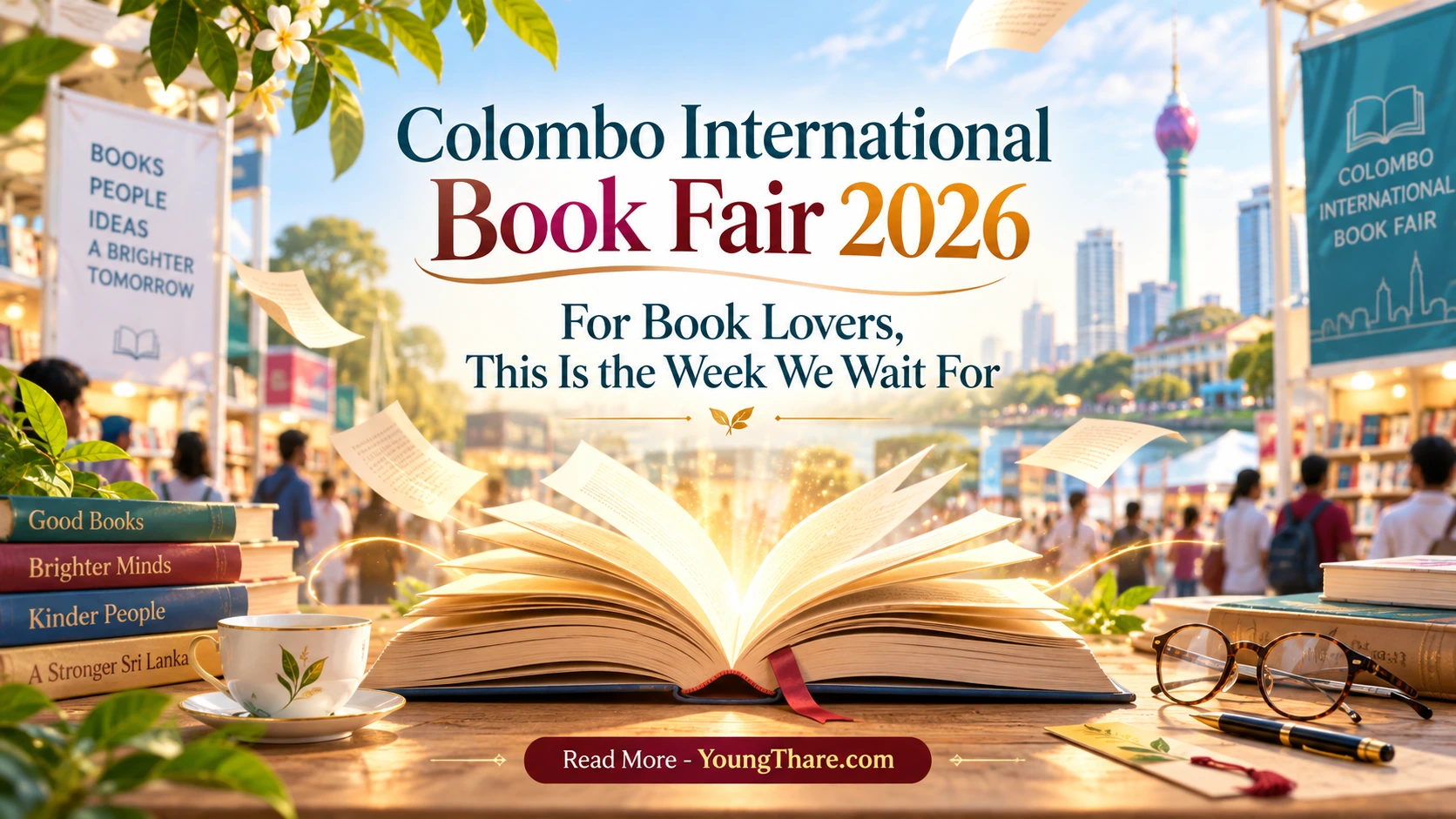
This Colombo International Book Fair 2026 guide is for the person who walks into a bookshop saying, “I’m only looking,” and somehow leaves with three books. It is for the reader whose to-be-read pile is already unreasonable, but who still feels there must be room for one more story. And it is especially for anyone who knows that September in Colombo feels slightly different once BMICH begins filling with books, publishers and thousands of people searching the shelves for their next read.
The Colombo International Book Fair 2026 is already underway, running from 25 September to 4 October 2026 at the BMICH, Bauddhaloka Mawatha, Colombo 07. The fair is open daily from 9.00 am to 9.00 pm, giving readers ten full days to wander, browse and return for the book they regretted leaving behind the first time. According to the International Publishers Association, this is the 27th Colombo International Book Fair, continuing an event that has become deeply connected with Sri Lanka’s annual reading calendar.
Colombo International Book Fair 2026 guide: what you actually need to know
The official CIBF site lists 70 leading local publishers and 32 international publishers, which explains why this is not the kind of place you properly explore in a rushed half-hour visit. There are familiar publishing names, books you have probably been meaning to buy for months and, if you are willing to browse instead of following only a shopping list, plenty of titles you may never have thought of searching for. The organisers have also published an official hall and stall map, which is worth checking before entering if you already know which publishers you want to find.
The fair is organised by the Sri Lanka Book Publishers Association, an organisation established in 1985 and now comprising more than 150 publishers, according to the International Publishers Association. What began as part of the country’s publishing community has grown into something much bigger in public life. The IPA describes the Colombo International Book Fair as a major ten-day national literary festival attracting around 1.6 million readers annually, a number that says something important about Sri Lanka and its relationship with books.
The strange happiness of getting lost at a book fair
A book fair works differently from buying a title online because you do not always arrive knowing exactly what you want. You notice a cover, read the first page, put the book back, walk away and then spend the next twenty minutes thinking about it. Somewhere between one publishing stall and the next, a writer you have never read before suddenly becomes someone whose book is travelling home with you.
That unpredictability is part of the pleasure. You may arrive searching for fiction and leave with history, essays, poetry or a subject you had never considered reading about before that afternoon. Book lovers know the small satisfaction of finding something unexpectedly good, especially when it was sitting quietly on a shelf surrounded by hundreds of louder choices.
There is also something wonderfully offline about the entire experience. For a few hours, your recommendations do not come from an algorithm, your next choice is not based on what everyone else is reviewing, and the book in your hand does not disappear because you swiped upwards. You simply look, read, compare, change your mind and occasionally buy a book because the first paragraph refused to let you put it down.
There is more happening than buying books
The official CIBF programme also includes book launches, discussions with writers, musical programmes, stage dramas and activities for children. That changes the atmosphere from a giant bookshop into something closer to a temporary cultural gathering. Readers are not simply coming to purchase something; authors, publishers, families, students and people interested in Sri Lankan literary culture are occupying the same space for ten days.
For younger readers in particular, those encounters matter. A novel stops being just an object on a shelf when you hear writers discuss how stories are created, or when you realise publishing itself is an industry filled with editors, illustrators, designers, writers and many other creative careers. Even if you attend only to browse, spending time around people who care deeply about books can make reading feel less like a solitary hobby and more like belonging to a much larger community.
Go with a list, but leave some space for surprise
There is nothing wrong with planning your visit. In fact, if there are particular authors, genres or publishers you want to find, making a small list and checking the official map can save a considerable amount of wandering. But organising every minute of a book fair also defeats part of the reason many of us enjoy going.
Leave enough room to stop at the stall you did not plan to visit. Pick up the strange little book whose title catches you from across the aisle, read the back cover and give yourself permission to discover something without already knowing whether the internet approves of it. Some books become favourites because we searched for them, while others enter our lives almost accidentally.
And perhaps set yourself a budget before entering BMICH. This is not an official CIBF recommendation; it is simply advice from one book enthusiast to another who understands exactly what can happen when “I’ll just have a look” meets several halls full of books.
Why the Colombo Book Fair still matters
There are endless conversations about whether young people still read, usually spoken as though an entire generation somehow stopped being curious the moment smartphones appeared. A literary event capable of drawing such a large public audience complicates that assumption. People may read differently now, discover books differently and move between printed pages, digital formats and social platforms, but the desire to find stories and ideas has hardly disappeared.
The Colombo International Book Fair also creates something that reading at home cannot: a visible reading culture. You see school students searching shelves, parents choosing books with children, university students comparing titles and adults carrying bags containing far more books than they probably intended to purchase. For several days, reading becomes unusually public, social and impossible to dismiss as a fading habit.
The book you did not know you needed may be there
If you have never been particularly interested in book fairs, you do not need to suddenly become the person who reads fifty novels a year before visiting. Go because you like one particular genre, because you want to find something useful for university, because a friend wants company or simply because you are curious about what thousands of Sri Lankan readers are searching for. There is no correct way to be a book person.
But if books already occupy an unreasonable amount of space in your room, this probably requires no convincing. The fair is open until 4 October, the shelves are waiting, and somewhere inside BMICH there is almost certainly another book you had absolutely no intention of buying. Whether it stays there is between you and your self-control.
For more youth, culture and lifestyle stories from Sri Lanka, explore YoungThare.