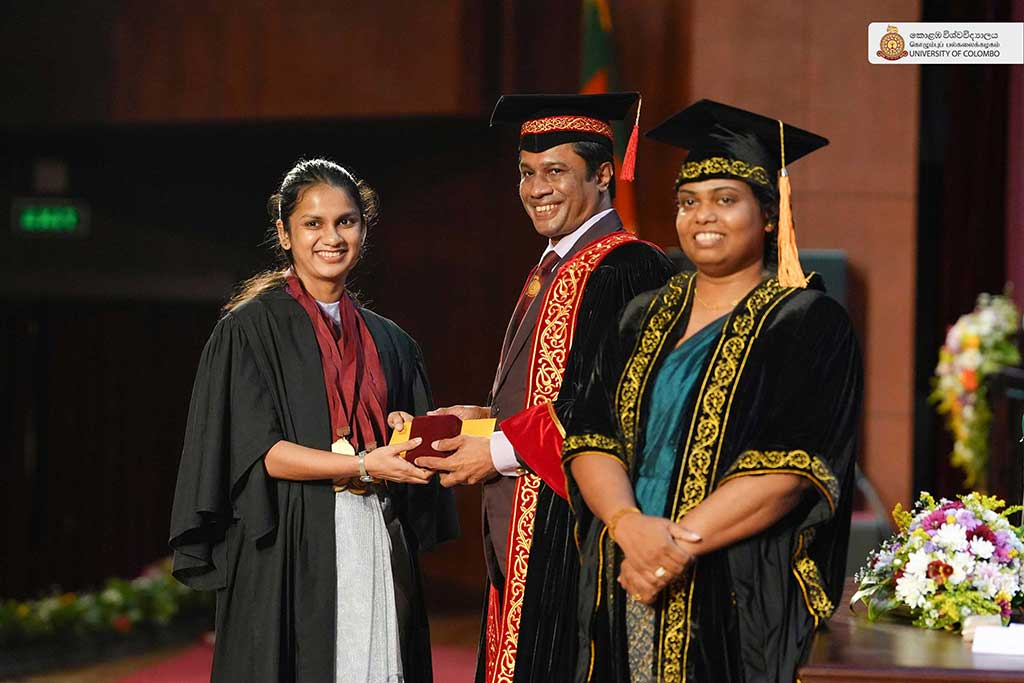
Hashini Rangika Epa Arachchi walked away from the University of Colombo’s medical degree programme with 16 gold medals, exactly half of the 32 gold medals awarded for the MBBS programme. That number alone is enough to make people stop scrolling, but it becomes even more remarkable when you look at what sits behind it. This was not one exceptional examination or one brilliant final year; it was academic excellence sustained across an entire medical degree.
At Phase I of the University of Colombo General Convocation 2025, held at BMICH on 22 May 2026, the Faculty of Medicine was among the faculties whose graduates received their degrees. The University later confirmed Hashini’s extraordinary academic record as part of its General Convocation and Open Awards coverage. For a generation constantly told that attention is everything, hers is a useful reminder that some of the most powerful achievements are built far away from attention.
Hashini Rangika Epa Arachchi won 16 of the MBBS programme’s 32 gold medals
Hashini was the Valedictorian of the 2018 A/L MBBS batch at the University of Colombo’s Faculty of Medicine. According to the University of Colombo’s official Open Awards record, she obtained First Class Honours in all five MBBS streams, including the Final MBBS examination. She then received 16 of the 32 gold medals awarded for the MBBS programme, an extraordinary concentration of academic awards for a single graduate.
That achievement becomes easier to understand when viewed as a record of consistency rather than simply a medal count. Medical education demands performance across different subjects, examinations, clinical settings and years of training, and Hashini maintained a level of achievement that repeatedly placed her at the top. Her undergraduate record also included multiple Dean’s List Awards and the Mitsubishi UFJ Foundation Scholarship.
There is no need to decorate those facts. Sixteen gold medals, First Class Honours across all five streams and a valedictorian position already say what needs to be said. Sometimes the strongest inspirational stories are the ones that do not need exaggeration.
First in Sri Lanka’s common merit list for medical internships
Her results did not stop at the University level. Hashini secured first place island-wide in the common merit list of MBBS graduates for internship appointments, placing her at the top among medical graduates considered through the national merit-order process. The University of Colombo separately reported strong representation among the top positions of the UGC Common Merit Order List for internship placements in 2026.
For a medical graduate, that ranking carries a different weight from a ceremonial prize. It reflects performance being compared beyond one batch or one faculty and across graduates entering the national internship system. Hashini therefore completed her undergraduate medical education not simply at the top of her university batch, but first on the island-wide merit list.
That distinction matters when telling her story accurately. It is easy to focus on the photograph with the medals because it is visually extraordinary, but the national ranking tells us something deeper about the academic record behind that photograph. The medals were not an isolated moment; they were the visible result of performance sustained over years.
The Professor Tilak Hettiarachchy Award added another level to the achievement
The University of Colombo also named Hashini as the recipient of the Professor Tilak Hettiarachchy Award for Academic Excellence, one of the University’s Open Awards presented in connection with the General Convocation 2025. The award considers more than examination results alone, recognising academic performance alongside areas such as undergraduate research, publications, scholarships, prizes and medals. Hashini’s wider undergraduate record made her a particularly strong fit for that recognition.
Her academic life did not remain within lecture halls and examination papers. She has contributed to medical research, including work on antenatal mental health and infectious disease. That combination; performing exceptionally in a demanding degree while also beginning to build a research record gives the achievement considerably more depth.
One of her published studies examined antenatal anxiety among pregnant women in the Colombo District. The research, published in the Ceylon Medical Journal, involved Hashini alongside fellow researchers and examined the prevalence and associated factors of antenatal anxiety among women attending antenatal clinics. The published antenatal anxiety research shows that her undergraduate academic work was already extending into questions with direct relevance to health and patient care in Sri Lanka.
Read the Previous Article: Why Many Gen‑Z Graduates Feel Lost: The Reality Behind the Degree
From examinations to medical research
Hashini has also written on scrub typhus, specifically the clinical importance of an eschar as a diagnostic marker. Her article, “Understanding Eschar: Pathognomonic Marker of Scrub Typhus,” appeared in the SAAP Journal of Integrative Physiology in 2026. The University additionally notes that she has presented research at national scientific forums, including the Sri Lanka Medical Association Annual Scientific Sessions, while remaining involved in research connected to dengue and interstitial lung disease.
These details matter because medicine is not a field in which a good university result is the final destination. Knowledge changes, evidence changes and the questions facing doctors change with them. A graduate who has already begun participating in research is learning not only how to use medical knowledge, but how that knowledge is produced and challenged.
For young Sri Lankans looking at Hashini’s achievement, that may be one of the more useful parts of her story. Academic excellence does not have to mean collecting marks and stopping there. At its best, education creates enough curiosity to keep asking better questions.
What 16 gold medals cannot show us
We do not know every detail of how Hashini studied, how many difficult weeks she had, which sacrifices were required or what her ordinary days looked like. It would be easy, and lazy to invent a dramatic version of those years simply to make the story sound more inspirational. What we actually know is enough: the results remained consistently exceptional across one of the country’s most demanding undergraduate programmes.
That is perhaps where the inspiration really sits. Achievement on this scale is rarely created by one burst of motivation before an examination; the record points instead to consistency maintained over years. For students currently sitting through lectures, repeating difficult chapters, questioning whether their work is getting them anywhere or simply trying to become slightly better at what they do, that distinction matters.
Sixteen medals make a headline. The discipline required to become the person capable of winning them is the larger story.
A Sri Lankan achievement worth celebrating properly
Hashini Rangika Epa Arachchi deserves recognition because what she achieved is genuinely difficult, not because we need to manufacture a heroic narrative around her. She graduated with First Class Honours across all five MBBS streams, became her batch valedictorian, ranked first island-wide for internship appointments, developed an early research record and received one of the University of Colombo’s major academic awards. Then there are those 16 gold medals.
For Sri Lankan Gen Z, especially students moving through universities and professional education right now, stories like hers have value beyond applause. They show what concentrated effort can look like when it is sustained long enough to become a body of work rather than a single result. There will always be louder forms of success online, but every so often someone quietly produces a record that makes noise all by itself.
Hashini did exactly that.
For more stories about Sri Lanka’s young achievers, ideas and people shaping what comes next, explore more from Youngthare.
Read the Previous Content in Blog: Learn & Improve